


Your Data Has a Memory. You Just Can't Access It.
A case study in nonprofit AI transformation by Roddye Communications

Fifteen years of service. Over 3,000 families. Nearly 10,000 case notes. 1,800 children documented across 18 different disability categories, served across 52 counties. Event records. Contact logs. Child-specific interventions. Grant program histories stretching back to 2008.
All of it existed. None of it was talking to itself.
Over fifteen years, this Parent Training and Information center had moved through three different CRM systems. Each migration did what migrations always do — it moved the surface data and left the connective tissue behind. Family records lost their links. Case notes lost their dates. Children who had been carefully connected to households in one system were floating, orphaned, in the next. By the time the third system came around, the organization had accumulated not one history but three separate, incompatible fragments of one — none of which could see the others.
488 records had no home at all. Nearly 700 families were in the system but had never been fully registered. And the case notes — 9,274 of them, representing over a decade of direct staff work with real families — were scattered across platforms that had never been designed to speak to each other.
The staff knew the history was there. They had lived it. They just couldn't reach it.
What This Actually Cost Them
This is the part that never makes it into a grant report or a board presentation, because it is invisible by nature. The cost of fragmented data is not a line item. It shows up in the small defeats that staff absorb every single day.
A family calls in. They have been working with this organization for seven years. Their child has Autism. There have been multiple case notes, multiple contacts, multiple staff members who built a relationship with this household. And the navigator who picks up the phone has no way to know any of it. They start from scratch. The family has to explain themselves again. The relationship the organization earned over seven years evaporates at the moment it was most needed.
A program director needs to know how many children with Autism are being served in Arapahoe County. There are 395 children with Autism in the data. There are 1,583 families in Arapahoe County alone. But pulling a clean answer requires manually searching across systems that don't share a common structure. The question takes hours. Sometimes days. Sometimes it simply doesn't get answered at all.
A new staff member joins. There are 26 staff members whose work lives in these case notes — years of institutional knowledge about how to navigate disability services, how to talk to families in crisis, which resources work in which counties. But because the data is disconnected, none of that knowledge transfers. New staff could eventually learn to do the work independently. What they could never do was collaborate — because collaboration requires a shared system, and there was none. Every staff member was working in their own silo, holding their own fragment of the organization's memory.
Leadership needed to report to funders. The organization runs programs under multiple grants. Demonstrating impact means showing who was served, how, and with what outcomes. But when the data lives across three broken systems, impact reporting is an exercise in estimation. The work was real. The evidence was buried.
"Before the AI, pulling a full family history often couldn't be done at all. Not slowly. Not imperfectly. Simply not at all."
The Questions That Revealed the Scale of It
When Roddye Communications came in, we asked the questions that expose what fragmentation actually looks like on the ground.
When a family calls in today, how do you know if you've worked with them before?
If a child was served in 2012 and the family comes back today, what can you tell them you already know?
If the executive director needs to know how many families in Jefferson County have a child with a Specific Learning Disability, how long does that take?
When a staff member leaves, where does everything they knew about their families go?
How long before a new navigator can work a full caseload independently — and can they ever truly collaborate with colleagues who came before them?
The answers confirmed what we had already seen in the data. This was not a small problem. It was a structural one, fifteen years deep, compounded by every system migration that had traded short-term convenience for long-term coherence.
What Roddye Communications Did
We did not start by building an AI. That would have been the wrong first move. An AI trained on fragmented data is just a faster way to be wrong. We started by doing what fifteen years of CRM migrations had failed to do — we made the data whole.
That meant taking 3,007 family records, 9,274 case notes, 3,315 event records, and 188 child-specific case notes spread across three incompatible systems and finding the thread that connected them. It meant building a unified primary key structure so that every record — every note, every event, every child, every contact — could be traced back to the family it belonged to.
It meant recovering 488 orphaned records. Case notes floating without a family. Children listed without a household. Contact logs with no anchor. One by one, cross-referenced against names, dates, service histories, and county records, they were matched and restored. 488 pieces of someone's story, given back their context.
It meant reconciling nearly 700 unregistered families — people who had received services, who had shown up, whose children had been helped, but who had never been formally brought into the system in a way that made them findable.
It meant building a data quality layer that didn't hide the scars of three migrations but surfaced them — flagging known discrepancies so that staff could make informed judgments rather than trust corrupted data blindly.
And then, once the data had integrity, we built the AI.
The system we built holds the entire fifteen years — every family, every case note dating back to January 2008, every event, every child, every disability, every county, every grant program, every staff interaction — and makes it conversational. Staff can ask about a family by name and surface their complete history in seconds. The executive director can pull population-level reports — disability breakdowns by county, families without recent contact, grant program reach across the service area — in the time it used to take just to locate the right spreadsheet.
Families who return to the organization no longer have to explain who they are. Their child's name, disability, grade level, case history, and the name of every staff member who ever worked with them — it's there. The relationship is intact.
And staff — for the first time — can collaborate. Because the knowledge is no longer trapped in individual silos. It lives in a shared system that every navigator, every program director, and every new hire can access equally. A staff member who joined last month has the same access to the organization's fifteen-year history as the person who was there for all of it.
The changes came in waves.
What Changed — By the Numbers
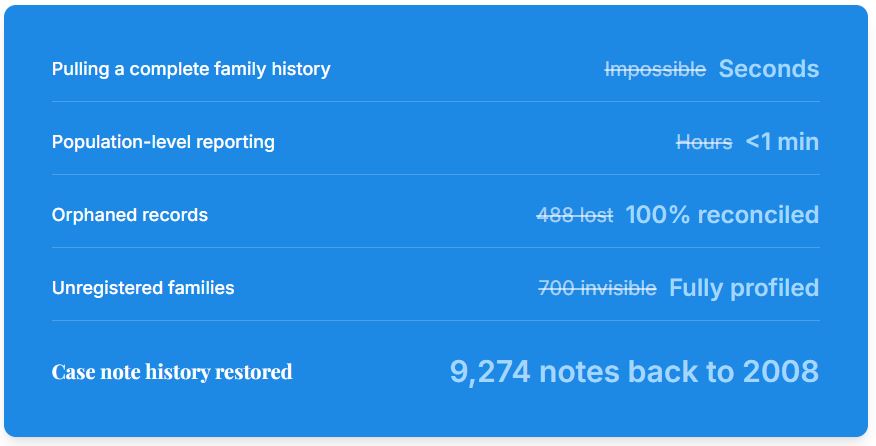
Pulling a complete family history
Impossible
Seconds
Population-level reporting
Hours
<1 min
Orphaned records
488 lost
100% reconciled
Unregistered families
700 invisible
Fully profiled
Case note history restored
9,274 notes back to 2008
What This Means for Organizations Like Yours
Data fragmentation is one of the most common and least-discussed problems in the nonprofit sector. It doesn't arrive in a crisis. It accumulates — through every system migration, every staff departure, every workaround that solved a short-term problem and created a long-term one. And by the time an organization recognizes it, the cost has already been paid. In families who had to start over. In reports that couldn't be written. In staff who worked hard and in isolation because there was no shared system to work within.
What Roddye Communications does is find what is already there and make it usable. We do not hand organizations a tool and wish them luck. We do the hard work of reconstruction first — because the data almost always exists. It just needs someone who knows how to listen to it, reconcile it, and build something worthy of it.
Fifteen years of work was sitting in this organization, invisible. It is not invisible anymore.
Roddye Communications — AI Strategy. Knowledge Systems. Nonprofit Digital Transformation.
Client details have been modified to protect confidentiality.
Is your organization sitting on years it can no longer see?
Tell us what you're working with. We'll show you what's possible.
© 2026 Roddye
Decisions shape what comes next.
Clarity makes them easier to stand behind.
TAKE THE FIRST STEP
