

Your People Are Your System. That's the Problem.
A case study in nonprofit AI transformation by Roddye Communications

Before We Arrived
Picture this organization. Small team. Big mission. They serve one of the most underserved populations in their state — immigrant families navigating the disability services system. Their staff are extraordinary. Many of them share lived experience with the families they work with. They speak the language, they know the systems, they show up every single day with a level of commitment you cannot hire or train.
And yet.
Ask any one of them where the intake form lives and you'll get three different answers. Ask what funder requirements looked like for the grant they submitted eighteen months ago and watch someone open four different folders before giving up. Watch a new community navigator spend their first three weeks following a senior staff member around just to learn the basics — not because the work is simple, but because no one has ever written it down in a way that transfers.
"This organization had an incredible amount of knowledge... What they did not have was any system that made that knowledge accessible to everyone on the team, every time they needed it."
When someone was out, the team improvised. When someone left — and in this sector, turnover is real — institutional memory walked out the door with them. Grant writing pulled the same two people away from families every funding cycle because they were the only ones who knew what to say and how to say it. Leadership spent hours every week answering questions that a well-designed system should handle automatically.
This was not a dysfunction. This was a completely typical, mission-driven organization doing important work — held back by an invisible problem that almost no one in the nonprofit sector has been taught to solve.
The Questions That Revealed the Scale of It
When Roddye Communications came in, we didn't start with technology. We started with questions.
What happens when your best program director is out for two weeks?
How long does it take a new hire to run an intake independently?
If a community navigator gets a question mid-client call that they don't know the answer to, what do they do?
When you're writing a grant application, where do you find last year's program description?
The answers told us everything. Staff were spending an estimated twenty to thirty hours per week collectively — searching for documents that existed but couldn't be found, re-explaining processes that had never been formally captured, answering questions that should have had a written answer somewhere, and rebuilding materials that had already been built before.
That's not just inefficiency. That's mission impact on the table. Every one of those hours is an hour not spent with a family.
What We Built — and How We Did It
Roddye Communications does not sell software subscriptions. We do not hand organizations a tool and wish them luck. We build custom AI-powered knowledge systems — and we manage them entirely on your behalf.
For this organization, that meant starting with a comprehensive audit of everything they had: every policy document, every HR form, every program SOP, every grant template, every intake checklist, every resource list, every training material. We organized it, structured it, and used it to train a custom AI knowledge assistant built specifically for this organization.
Not a generic chatbot. Not ChatGPT with a logo on it. A purpose-built internal knowledge system that knows this organization's mission, programs, staff structure, geographic service areas, Medicaid and disability benefit workflows, HR policies, grant history, and community resources — and can answer questions about any of it, instantly, in plain language, for anyone on the team.
We then trained every staff member, volunteer, and intern on how to use it for their specific role. We ran live sessions. We built role-specific guidance. And we stayed — because a knowledge system that isn't maintained is a knowledge system that becomes outdated and irrelevant within months.
What Changed
The changes came in waves.
Onboarding
A new community navigator spent day one asking the system questions about procedures and forms. By week two she was running intakes independently.
Grant Writing
The program director asked the system for program descriptions and drafted a statement of need using the organization's own language, finishing a first draft in under two hours.
Intake & Navigation
Navigators could ask the system mid-workflow about Medicaid waivers or required documents and get accurate, step-by-step guidance without interrupting a supervisor.
HR & Leadership
Questions moved from "interrupt someone who knows" to "ask the system". Executive time shifted toward strategy, funder relationships, and community presence.
The Hours, By the Numbers
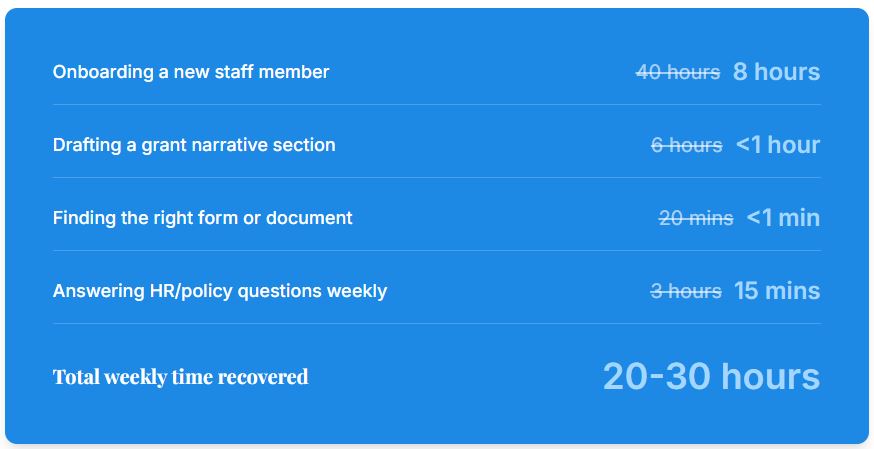
Onboarding a new staff member
40 hours
8 hours
Drafting a grant narrative section
6 hours
<1 hour
Finding the right form or document
20 mins
<1 min
Answering HR/policy questions weekly
3 hours
15 mins
Total weekly time recovered
20-30 hours
That's a part-time staff position worth of capacity — returned to direct service, to families, to the mission. Every week.
What This Looks Like Long-Term
Here is what most organizations miss about AI knowledge systems: they compound.
Every document added to the knowledge base makes the system more useful. Every new program, every updated policy, every new grant cycle becomes part of what the system knows. An organization that builds this system today will have a fundamentally more capable, more efficient, more resilient operation in twelve months than they do right now — and the gap between them and organizations that didn't build it will widen every year.
When staff turn over, the knowledge stays. When leadership transitions, the institutional memory remains. When a new program launches, it gets documented and absorbed into the system from day one rather than living in the head of whoever designed it.
This is what it means to build a learning organization — not as an aspiration, but as an operational reality.
Who This Is For
If your organization has passionate staff, important work, and a growing sense that you are one departure or one bad grant cycle away from something going seriously wrong — this work is for you.
If your executive director is still the answer to questions that a well-documented system should handle — this work is for you.
If your team spends meaningful time every week searching for things they know exist but cannot find — this work is for you.
We work with nonprofits, advocacy organizations, community health providers, disability service organizations, legal aid groups, immigrant services organizations, and mission-driven teams across every sector. The populations differ. The problem is almost always the same.
What Roddye Communications Does
We build, train, and manage custom AI knowledge systems for organizations that are ready to stop running on improvised processes and start operating with the infrastructure their mission deserves.
We handle everything. The audit. The build. The training. The ongoing management. The updates as your organization grows. You do not need an IT department. You do not need technical expertise. You need a team that is ready to use a better system — and we build that system for you.
We also pair AI knowledge systems with rebuilt web presence, SEO strategy, content development, CRM implementation, social media management, and digital infrastructure — because an organization that runs efficiently internally should also be found by the communities and funders it serves.
If you are ready to have a conversation about what this looks like for your organization, we are ready to listen.
Roddye Communications — AI Strategy. Knowledge Systems. Nonprofit Digital Transformation.
Client details have been modified to protect confidentiality. The outcomes described reflect real operational results.
Want to know what your organization's knowledge system could look like?
© 2026 Roddye
Decisions shape what comes next.
Clarity makes them easier to stand behind.
TAKE THE FIRST STEP
